Fan listings love to say “large,” and large means nothing. A 9-inch souvenir fan and a 13-inch festival clacker look identical in a product thumbnail, but they are different objects in the hand: different span, different sound, different price by an order of magnitude. If you are ordering custom fans for an event, the size class is the first spec to lock down, because it drives the budget, the print area, and whether the crowd can actually hear the clack. Here is how the size classes compare and how to pick between them.
The four size classes
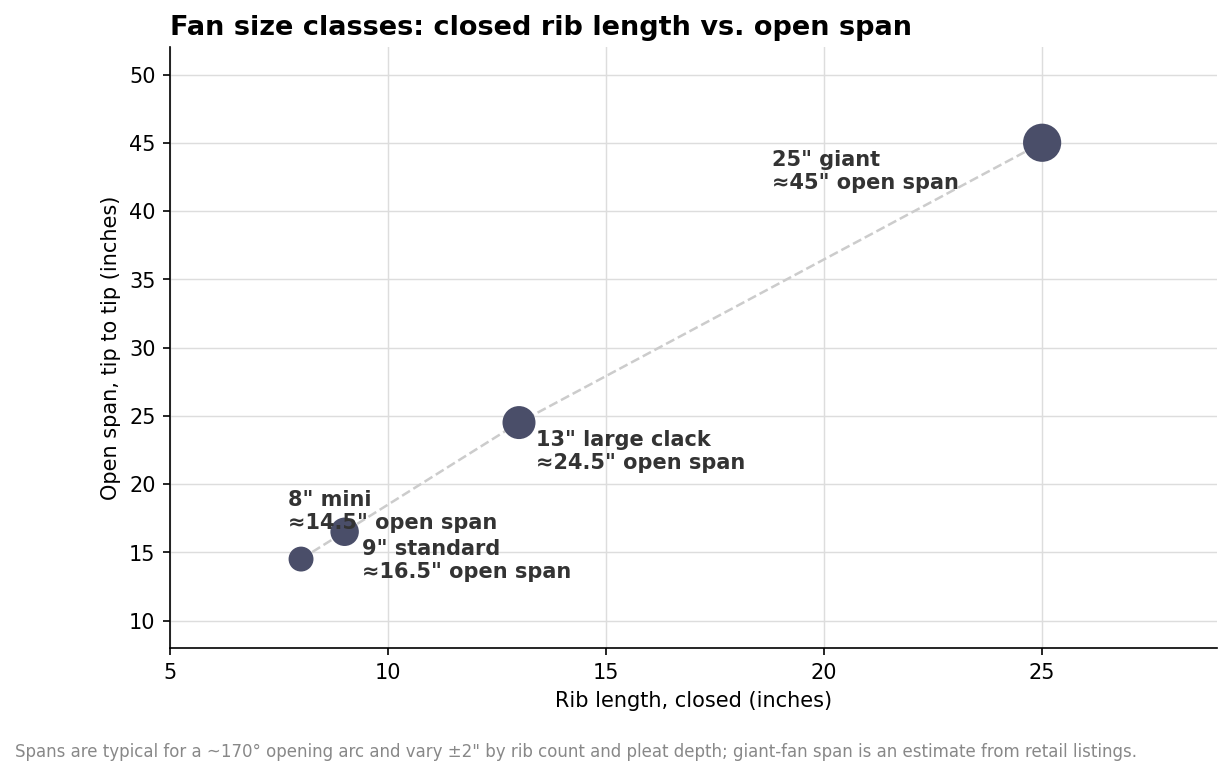
Fan sizes are quoted by rib length — the closed length of the fan from rivet to tip. The common classes are the 8-inch mini, the 9-inch standard (the classic 23cm souvenir and wedding fan), the 13-inch large clack fan (33cm, the festival and drag staple), and the 25-inch giant, a performance prop more than a crowd item. Open span scales faster than rib length because the arc widens too: a 9-inch fan opens to roughly 16 to 17 inches tip to tip, while a 13-inch clacker opens to about 24.5 inches, and giants spread to around 4 feet. That span is your real print canvas — a 13-inch fan gives you roughly half again the artwork width of a 9-inch fan, which is why bold logos that get lost on a standard fan read clearly on a clacker.
Why the 13-inch fan clacks and the 9-inch mostly doesn’t
The clack comes from the ribs slapping together when the fan is snapped open with a flick of the wrist. Longer, heavier bamboo ribs carry more momentum, so the 13-inch class produces the loud crack — sellers describe it as a “loud snap” or “thworp” — that reads over festival noise. A 9-inch fan with light ribs opens with a polite flutter; it cools fine and photographs fine, but nobody across the dancefloor hears it. Construction matters as much as length: fans built for clacking use thicker rib stock, reinforced metal rivets, and tightly bonded fabric — usually nylon or polyester rather than paper — because the snap that makes the sound is also what destroys cheaply riveted fans. If the clack is the point of your event fan, do not order a 9-inch paper fan and hope; it will neither clack nor survive the attempt.
What each class costs
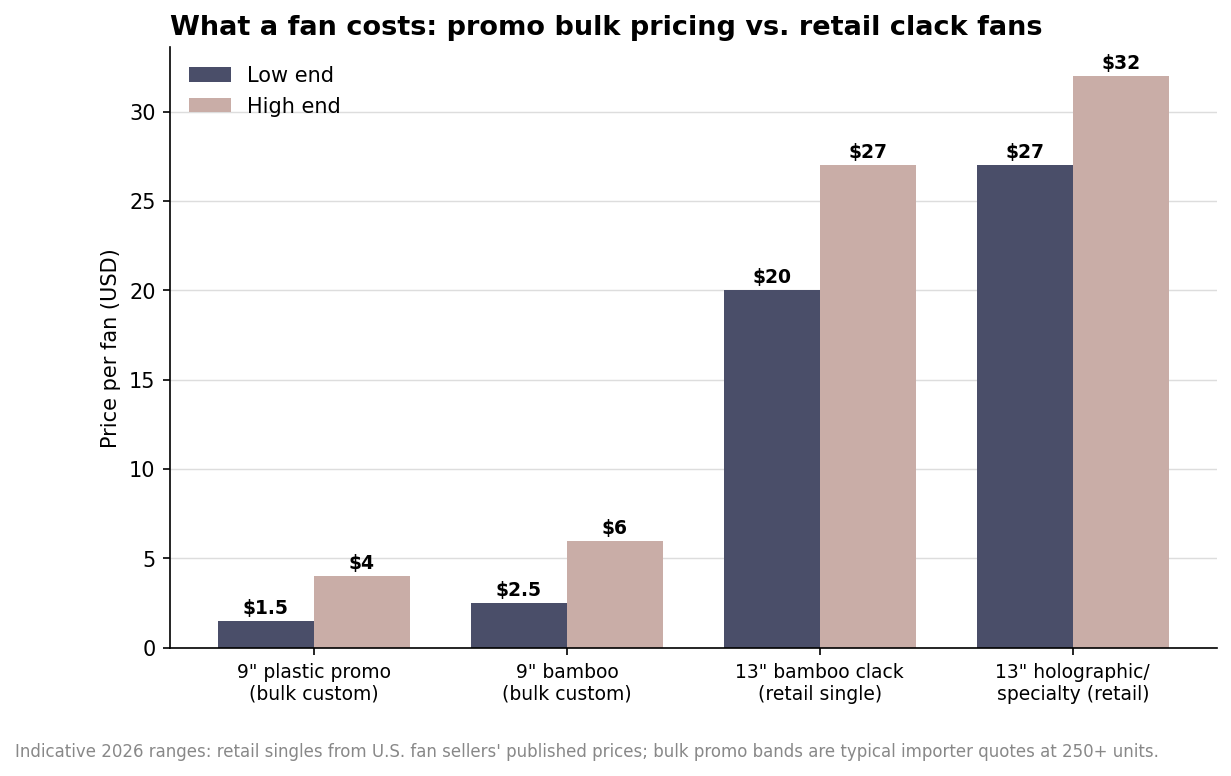
The price gap between classes is bigger than most buyers expect. Bulk custom 9-inch plastic promo fans run in the low single dollars per unit at a few hundred pieces, with bamboo-ribbed 9-inch versions a step above that. Retail 13-inch bamboo clack fans from U.S. specialty sellers list around $20 to $27 each, with holographic and specialty finishes topping $30 — and bulk custom orders of the same class land well below retail but still several times the promo-fan price, because you are paying for heavier bamboo, more fabric, and sturdier hardware. These are indicative 2026 ranges, not quotes; volume, fabric, and print method move them. The budget logic follows: a 500-guest giveaway where the fan is a branded keepsake points to the 9-inch class, while a 50-performer entrance or a VIP gift where sound and spectacle matter justifies 13-inch clackers.
Matching class to event
For weddings and conference swag, the 9-inch standard is the right default: it fits favor boxes and printed programs, it is light enough that guests carry it all day, and the unit price lets you order one per seat plus spares. For Pride, raves, and drag events, the 13-inch clacker is the expected object — the crowd knows the sound, uses it as applause, and keeps a good one for years, which stretches your brand impression far past the event date. Giants are for the stage: one or two in a performer’s hands, not hundreds in a crowd, and usually a custom one-off rather than a print run. If you are torn between classes for a mixed event, split the order — clackers for performers and VIPs, standards for general attendees — rather than compromising on a mid-size that does neither job well.
Weight, carry, and the day-after test
Weight is the spec nobody lists and everyone feels. A 9-inch plastic promo fan weighs an ounce or two and disappears into a pocket; a 13-inch bamboo clacker is a palpable object — several ounces of dense rib stock — that guests carry in hand or in a belt holster, which is why many 13-inch retail fans ship with one. That difference decides what happens after the event. Light standards get tucked into bags and make it home as keepsakes almost by default; clackers get used hard for hours, and the ones that survive become part of an attendee’s regular festival kit. Sellers in the 13-inch class lean into this with durability language — fans “built to survive the longest sets” — and some back it with warranties, which tells you where the engineering effort goes in that class. For a buyer, the practical test is simple: imagine your fan at hour six of the event. If it needs to still be snapping crisply then, buy the class built for it. If it needs to be light enough that nobody puts it down, buy the smaller class and spend the savings on better print coverage.
Spec checklist before you order
When you request a quote, state the rib length in inches, the rib material and count, the fabric (nylon holds print and abuse better than paper at every size), rivet construction if clack volume matters, and your artwork’s orientation across the pleats. Ask the supplier for the open span and weight of the exact model, since two 13-inch fans can differ by a couple of inches of span depending on rib count and pleat depth. And order a physical sample before committing to hundreds of units: the clack test takes five seconds in hand and is impossible from a product photo. Size class first, construction second, artwork third — get those in order and the fan will do its job loudly.
Leave a Reply